The Scapegoat's Burden
They didn't cause the chaos. They just stopped pretending it wasn't there. How dysfunctional families punish the truth teller.

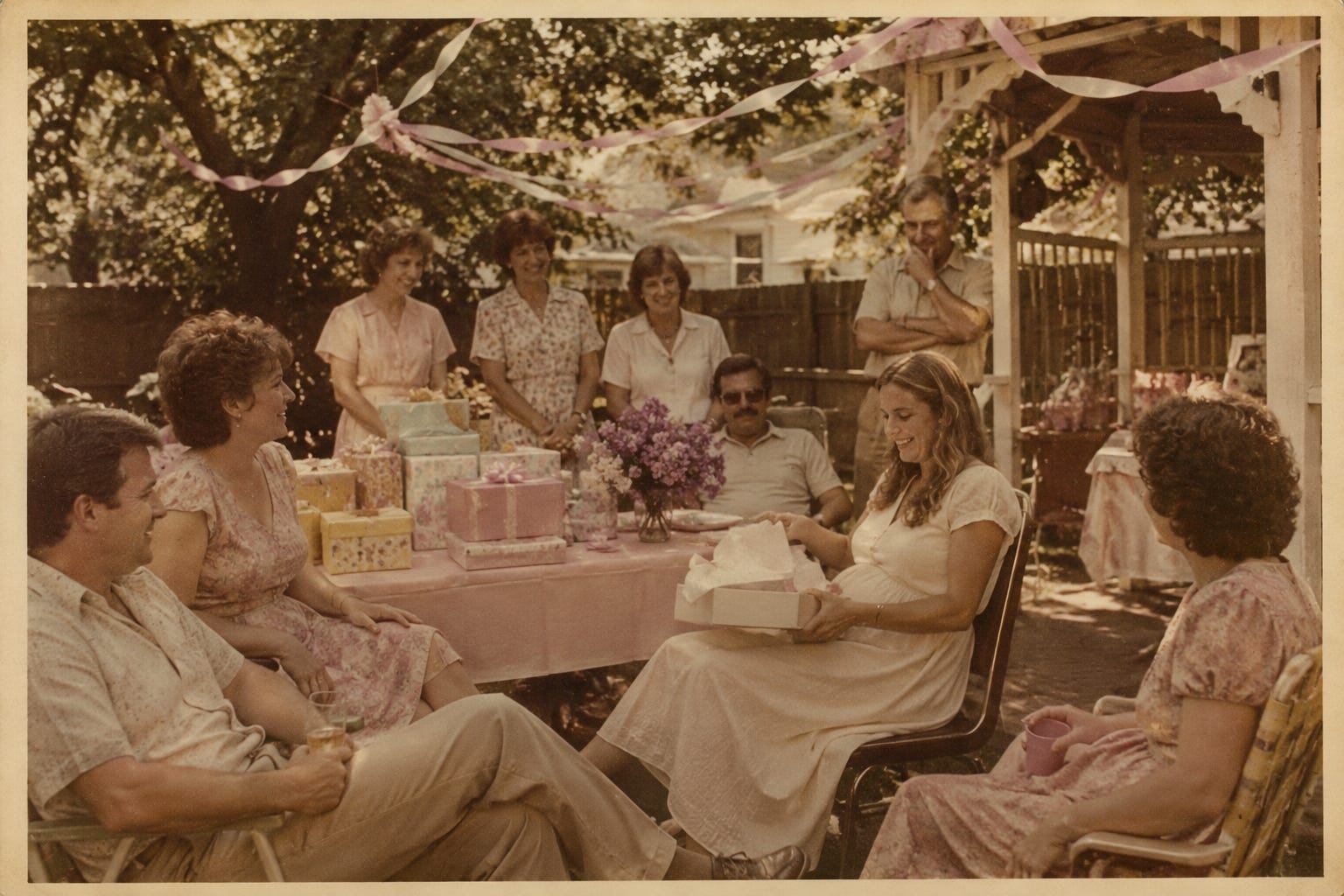
The backyard was already decked out. Pink and gold streamers looped between the fence posts, a balloon arch framed the gazebo, and the punch bowl sat ready with floating scoops of rainbow sherbet and a layer of foam on top. Tables draped in pink linens held bunches of purple lilacs as centerpieces.
It looked like the kind of family people envy.
The kind that seems happy from a distance.
Dana was checking the guest list against her to-do list while her mother, Margaret, folded utensils into napkins at the dessert table. Nearby, her sister Renee picked up the folded gift table from against the fence.
“Move the gift table closer to the gazebo, please,” Dana said.
Renee glanced over, amused. “Look at you, still doing your little party thing.”
“It’s not a little thing Renee. It’s my business. Has been for years. I just did a charity gala for four hundred people last month.”
“Sure, sure.” Renee shrugged. “It’s cute that you still keep busy with your hobby.”
Margaret looked up from her napkins. “Did either of you talk to the caterer about the cake table placement?”
Neither of them answered her. She didn’t push. She just went back to folding.
“It’s not keeping busy Renee. And it’s not a hobby. I run a business.”
“Okay, okay, don’t get so defensive.” Renee laughed it off, looking toward her mother like she expected backup. “Here she goes, Mom. She does this every time.”
“I’m not defensive, I’m correcting you.” Dana continued.
Margaret kept folding napkins. “Let’s just focus on getting everything set up before people start arriving. Can we, girls?”
That was it. No correction for Renee. No acknowledgment of what Dana had actually built. Just a redirect, the same one Margaret always reached for when something got uncomfortable.
Dana carried the gift table the rest of the way to the gazebo herself.
She also already knew her mother was too much of a coward to say anything.
If you’re new here, quick context: the Calhouns are a fictional family we’ve been using across this series to show what toxic family systems actually look like in action. Dana is the scapegoat. If you haven’t read the first two essays, this one will still make sense, but you’ll see a lot more once you do.
The Origin of the Scapegoat
The word didn’t start in a family kitchen. It started in the Holy Bible, in the book of Leviticus.
In the ancient ritual, the community would gather once a year and lay their collective sin onto a single goat.
Every transgression. Every failure. Every shameful thing nobody wanted to claim as their own, placed onto one animal who had done absolutely nothing to deserve any of it.
Then they drove that goat out past the edge of the camp, out into the wilderness, alone, to wander with the weight of everyone else’s wrongdoing on its back while the rest of the community returned home clean.
The community felt relief.
The goat did not.
That structure hasn’t changed in thousands of years. Only the species.
In dysfunctional families, the role gets handed to a person instead of an animal, but the mechanism is identical.
One member absorbs what the rest of the family can’t or won’t carry. The family feels lighter.
The scapegoat carries the weight, alone, while everyone else goes back to pretending nothing happened.
It’s not a metaphor anymore. It’s a mechanism. And once you see it, you can’t stop seeing it.
When the Goat Becomes a Person
Therapists call the scapegoat in dysfunctional family systems the identified problem, also called the identified patient. The one visible symptom of an entire family’s invisible dysfunction.
Here’s what that actually means.
Every family carries stress, conflict, and pain it doesn’t know how to handle.
In a healthier family, that weight gets shared, talked through, processed together, with no malice, no triangulation, and no need to redirect blame.
In a dysfunctional one, it gets handled a little differently. It often gets funneled onto one single person instead, who now becomes the explanation for everything wrong. Which means nobody else has to look at themselves.
Family systems researchers call this triangulation. When tension between two people becomes too uncomfortable to face directly, a third person gets pulled in. Sometimes a fourth. Sometimes the whole rest of the family.
Not to help resolve it. Not for advice. Just to spread it around and choose sides.
This is the part that’s hardest to hear, and the most important to understand.
The role was assigned. Not earned.
Nobody sits down and votes on who becomes the scapegoat.
It happens slowly, through a thousand small moments where one person’s honesty becomes more inconvenient than everyone else’s avoidance.
The scapegoat didn’t create the dysfunction. They just stopped pretending it wasn’t there.
Death by a Thousand Cuts
Presents were being opened one by one. Dana and Tom sat near the gazebo with the gift table beside them while Margaret handled the present exchange.
Everyone else watched from their lawn chairs, seated beneath the big oak tree that protected them from the sun.
Dana opened a breast pump, holding up the box. “Thank you.”
Gary, sitting in the chair closest to the side door to the garage, the one that held the liquor inside the mini fridge, leaned back. “Just give the kid a bottle. We all turned out fine.”
“Breastfeeding has better benefits Gary,” Dana said.
“I don’t get the whole breastfeeding thing either,” Brenda chimed in. “Nobody in this family ever did it. We all turned out just fine on formula.”
“Same,” Renee added, not even looking up from her phone. “I never once wanted my boob in some kid’s mouth. I got better things to do.”
“Bottle never hurt anybody,” Kristy chimed in.
“If you guys wanna feed your kids fast food out of a bottle, that’s your call,” Dana said. “I’d rather give mine whole foods. You do what you want.”
“You have to be so rude Dana,” Brenda said. “That was kinda hurtful.”
Gary just shrugged. “Must be nice having all day to worry about this kind of stuff and the luxury to breastfeed your kid. Rest of us have real jobs and real problems.”
The yard went silent. Nobody corrected him. Nobody said a word in her defense.
Dana set the box down carefully, like she was trying not to throw it.
She ran a business.
She cooked. She cleaned.
She took care of her husband.
She was seven months pregnant.
She’d painted the entire nursery herself.
She was in therapy, doing the work nobody else in this family had ever bothered to do.
And somehow this family had decided she had nothing but free time and a credit card.
Tom reached over and squeezed her hand, just enough pressure to say I see it. Don’t give them the reaction they want.
Gary just laughed as he walked off toward the garage.
The Black Sheep Effect
There’s a name for what just happened in Dana’s family. Psychologists call it the black sheep effect.
It’s not about what gets said.
It’s about who said it.
Gary insults people and everyone laughs.
Renee dismisses Dana’s business as a hobby and nobody blinks.
Brenda criticizes her parenting choices and it’s just a conversation.
But the moment Dana pushes back, suddenly she’s defensive. Rude. Too sensitive. Difficult. Dramatic. A bitch. Out of line.
The behavior isn’t being judged equally. The person is.
That’s what makes the black sheep effect so confusing for the person living inside it. They spend years trying to understand the rules, never realizing the rules were never applied fairly to begin with.
The same honesty that gets praised in one family member gets punished in another.
The same frustration that’s understandable coming from everyone else becomes evidence of instability when it comes from the scapegoat.
The same boundary that would be respected from somebody else becomes selfish, cold, or mean when they set it.
Not because they actually did anything worse.
Because the family has already decided who they are.
Once someone gets assigned the role of black sheep, (scapegoat) everything they do gets filtered through that story.
Their mistakes are remembered longer.
Their motives are questioned more often.
Their reactions are scrutinized more closely.
Even their strengths become suspicious.
And eventually, the family stops responding to what the scapegoat actually does.
They start responding to who they’ve already decided the scapegoat is.
The Breaking Point
Later, as the men loaded gifts into the car, Dana went inside for some water and caught the tail end of a conversation between her three sisters. Brenda, Renee, and Kristy.
“...cabin sleeps ten, so we just need to figure out who’s driving up Thursday versus Friday—”
Dana stepped into the kitchen. “What cabin?”
The table went quiet half a second too long.
“We’re all going up to the mountains next month,” Renee said.
“What are you talking about? Who’s going?”
“All of us. The family. We just figured with the baby coming you probably wouldn’t want a whole mountain trip.”
“That wasn’t your call to make,” Dana said. “And I thought we decided we weren’t doing a family trip this year. That’s what we agreed on back in the spring.”
“We just figured, since you were having a baby, we’d change it up,” Renee said. “We figured you wouldn’t wanna go, so we just planned it without you. We weren’t trying to be hurtful.”
“It feels like I’m being excluded from my own family.”
“That’s not true,” Brenda said quickly. “Nobody’s excluding you. We just figured—”
“We’re not doing that to you Dana,” Renee added. “You’re reading way too much into this.”
“Here we go,” Brenda said, looking at Renee. “There’s Dana.”
Something in Dana’s chest finally cracked all the way open.
“You’re right,” she said. “Here’s Dana. The one who actually says things out loud instead of whispering them behind each other’s backs for ten years.”
“Don’t be so dramatic, nobody did anything to hurt your feelings” Kristy chimed in.
“I’m not being dramatic!! Earlier today my business was cute. Then Gary told me I have nothing but free time while I’m seven months pregnant running a household and a company. Brenda called me rude for saying I’d rather feed my own kid in a healthier way. And now I find out you planned an entire trip behind my back and decided for me that I wasn’t invited, and not one of you thought that was worth an actual conversation.”
“Nobody said you weren’t invited—”
“You didn’t have to say it. You just never asked and assumed I couldn’t go.”
Margaret stood near the door, dish towel in her hands.
“Can we just let it go girls,” Margaret finally said. “It’s not that big of a deal. If you wanna come Dana, you can. Otherwise there’ll be plenty of other trips.”
“This is the problem with this family,” Dana said, voice shaking now. “Nobody talks to anybody directly. Everyone talks behind each other’s backs and calls it keeping the peace. Nobody can sit through one honest conversation without somebody storming off or somebody else jumping in to defend whoever’s uncomfortable. I am so tired of being the only one who says the thing everyone else is thinking and then getting treated like I invented the problem.” Tears streaming down Dana’s face.
Everyone stood in silence.
Tom walked in, catching the tail end of it, his eyes landing on his wife.
“You’re out of line Dana,” Brenda said, shaking her head.
Nobody said that to Gary an hour ago. Nobody said it to Renee. Nobody said it to Brenda. Just Dana.
“It’s not the trip,” Dana said. “It’s never just one thing. This is decades of nobody having a real conversation in this family. Decades of ignoring the real problem and pointing at anybody but the real problem. And somehow I’m the one who ends up the scapegoat every single time. I’m done being the only one who’s not allowed to have a bad day, to say something, or to do anything worth acknowledging. I’m done with this family. I’ve been in therapy for years and I see exactly what’s going on here, and I am so fucking done with it!!”
She turned to Tom. “We’re leaving.”
She kissed her mother on the cheek. “And we’re not coming back.”
She walked out without saying another word. Nobody followed them to the door. Nobody stopped them, assuming she’d be back in a few weeks once she was done with her latest tantrum, the same way the scapegoat always was.
But this time was different.
This time, Dana had had enough. She was not going to bring her child in this dynamic.
It would be the last time she ever walked through that door.
What Happens Now
The Calhouns will tell their version of this story for years.
Dana overreacted.
Dana always makes it about herself.
Dana’s the one with the outbursts.
This is who Dana is.
That Dana was the toxic b!tch they’re no longer affiliated with.
That’s the version that’s easier to live with. It always has been.
The truth is simpler, but harder to sit with. A woman who spent decades being the only one in her family willing to say what nobody else would say finally ran out of room to keep carrying it alone.
The scapegoat doesn’t always leave loudly.
Most of the time they just slowly stop showing up.
Stop answering the calls.
Stop hoping it’ll be different this time.
But every single one of them reaches a moment like this one, the moment the cost finally outweighs whatever thin thread of belonging that kept them coming back.
Next week, that’s where we go. The burden, and the gift, of the scapegoat finally walking away. What it costs to leave, and what they get back once they finally do.
If you’ve ever been the one in your family who couldn’t just let it go, you already know what’s coming.
Now It’s Your Turn
If you’ve ever been the family scapegoat, or you’re realizing for the first time that you might be, tell me about it in the comments. I want to know what your version of “there’s Dana” sounds like.
And if this one hit close to home, please comment, like, share, or subscribe.
If you missed the first two pieces in this series, you can catch up here: the cast of characters inside a dysfunctional family system, and the toxic parents who created them in the first place.
Further Reading, Watching, and Listening
Books
Murray Bowen, Family Therapy in Clinical Practice. The foundational text on family systems theory and triangulation.
Pia Mellody, Facing Codependence. Essential reading on how dysfunction gets passed down and why enabling feels like love.
Lindsay Gibson, Adult Children of Emotionally Immature Parents. The conflict avoider and stonewaller bible.
Susan Forward, Toxic Parents. She named a lot of what this series describes before anyone else did.
Mark Wolynn, It Didn’t Start With You. On intergenerational trauma and how family patterns live in the body long after the family is gone.
Gabor Mate, The Myth of Normal. On how dysfunction gets normalized and why we don’t see it until we do.
Harriet Lerner, The Dance of Anger. On how families organize around anxiety and why the truth-teller becomes the target.
YouTube
Patrick Teahan. His video on the family scapegoat role is essential, and everything else he makes is worth watching. Search his name and start anywhere.
Lisa A. Romano. Breakthrough life coach and bestselling author specializing in codependency, narcissistic abuse, and dysfunctional family systems.
Canaries in the Coal Mine. Honest, raw content on surviving toxic family systems and the long road out of them.
Terri Cole. Licensed therapist and boundary expert. Her content on high functioning codependency and family patterns is some of the most practical out there.
Articles
Laura K. Connell, “Are You the Family Scapegoat? Here Are 9 Signs.” A clear, practical breakdown of how to recognize the role from the inside.
Annie Wright, LMFT, “The Family Scapegoat: A Complete Guide to Healing.” A deep clinical resource on triangulation, projective identification, and what recovery actually requires.
Podcasts
Adult Child, hosted by Andrea Ashley. For adult children of alcoholics and anyone raised in a dysfunctional home.
Sherapy Sessions, hosted by Dr. Sherrie Campbell. Specifically on toxic family dynamics and how to heal from them or cut ties entirely.
Being Well, hosted by Dr. Rick Hanson and Forrest Hanson. Practical episodes on managing old family patterns and setting boundaries.
The Complex Trauma Podcast, hosted by Sarah and Abby. Deep dives into family dysfunction, complex trauma, shame, and abandonment.
Research
John Gottman on stonewalling. The Gottman Institute, gottman.com.
Robert Felitti, The ACE Study. On adverse childhood experiences and their lifelong impact.
THIS 👉 But the moment Dana pushes back, suddenly she’s defensive. Rude. Too sensitive. Difficult. Dramatic. A bitch. Out of line.
Sadly I relate to Dana. Detachment carries the trade off that has a price too. Being the Black Sheep for me is something that I still deal with. Building another family system helps.